
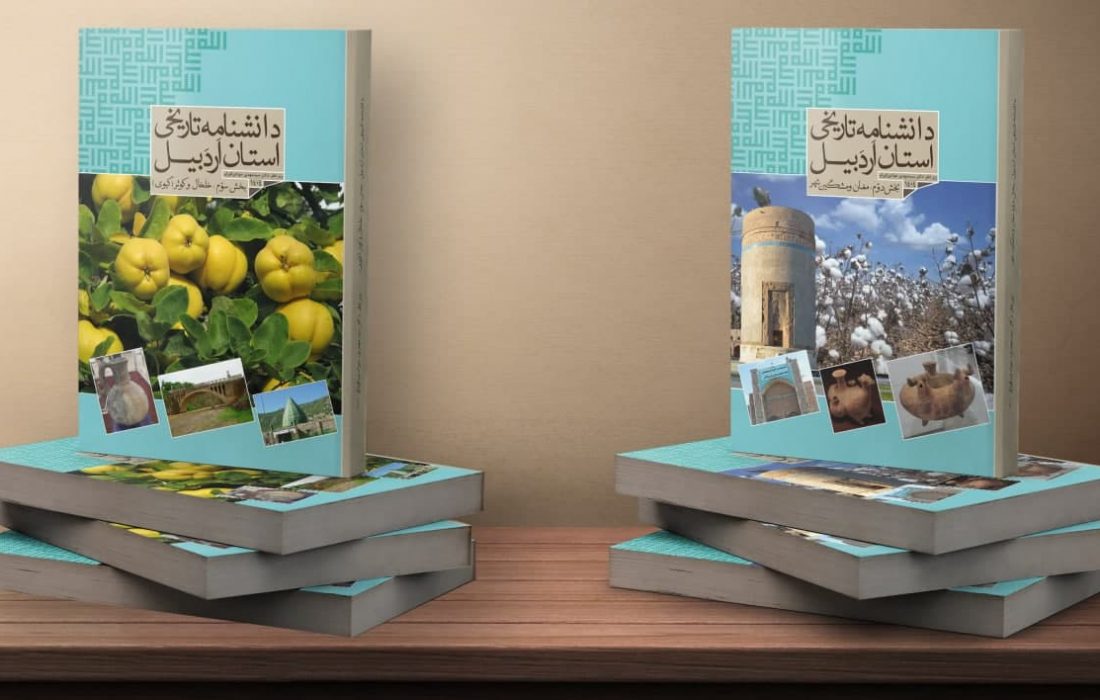
According to Nasim Ardabil, Seyed Mehdi Javadi, the scientific and executive head of the Historical Encyclopedia of Ardabil, announced in a meeting of the Scientific Council of the encyclopedia that the second volume, covering the counties of Moghan and Meshginshahr with 579 pages, and the third volume, covering the counties of Khalkhal and Kosar with 293 pages, have been prepared. With the approval of Ayatollah Seyed Hassan Amoli, the province’s representative in the Assembly of Experts and the founder of this project in Ardabil, and the endorsement of the Scientific Council, these volumes have been published in a limited edition by Mohaghegh Ardabili Publications.
Referring to the publication and unveiling of the first volume of the encyclopedia (focused on the center of Ardabil province) in 2021, Javadi stated in a meeting of the Provincial Council for Public Culture attended by Hadad Adel, president of the Academy of Persian Language and Literature: “Undoubtedly, the proper unveiling of these two valuable works, covering the northern and southern regions of the province, along with recognition of the active researchers in this field, is one of the serious demands of the people, as well as cultural and historical communities of the province, especially ahead of the upcoming visit of the President to Ardabil.”
Javadi expressed appreciation to the members of the Scientific Council, noting the significant role of the Supreme Leader’s representative in the province and some cultural officials in initiating this scientific project. He added that the compilation process of this encyclopedia began in 2019 under provincial research projects and, with the participation of more than 65 university professors, authors, and researchers from inside and outside the province, four volumes have been completed to date.
He continued that the only remaining volume concerns the counties of Namin, Nir, and Sarein, which is part of a provincial research project. About 60% of it has already been completed. Efforts are being made to prepare this volume for publication by the end of the current year, so that its release as the fourth and final volume will make this comprehensive historical encyclopedia available to researchers and enthusiasts.
Javadi also highlighted the distinguished features of the encyclopedia: in addition to its uniqueness at the provincial and national level, the preface by Hadi Alamzadeh—a prominent professor of Islamic history and civilization at the University of Tehran and a well-known figure in encyclopedia writing in Iran—adds significant scholarly value to the collection.
He mentioned some specific advantages of the encyclopedia, including entries on the historical geography of cities and regions, translations of the foreword into Arabic, English, and Azerbaijani Turkish, coverage of less-studied topics such as the presence of Sunni communities, Kurdish tribes, newly discovered historical sites, vertebrate fossils, the depiction of Moghan in foreign encyclopedias, the Shahsevan tribes, prehistoric castles of the province, the Khalifehlu family in Moghan, the historical geography of Sabalan, and the history of ancient cities such as Barzand, Bajravan, and Varthan (Ultan). Attention to tourism and ecotourism potential is another distinctive feature of the work.
He invited researchers and experts to submit their comments and suggestions for review by the Scientific Council and possible inclusion in future editions.
Regarding the commitment of the compilers to completing this scientific project, Javadi said that only one meeting between the Scientific Council members and the Ardabil governor has been held so far. He hopes that regular meetings with the province’s highest government representative will strengthen the motivation of the scientific team and ensure the voluntary project progresses while addressing its challenges and needs.
In conclusion, Javadi outlined some expectations from provincial officials, including: utilizing the expertise of local researchers involved in compiling the encyclopedia, providing part of the authorship fees for the Scientific Council members of the published volumes, offering special support for reprinting these works due to the province’s pressing need, and providing necessary assistance for the timely publication of the final volume.
It is worth noting that Seyed Mehdi Javadi, the scientific and executive head of the Historical Encyclopedia of Ardabil, was recognized in 2024 as a top provincial expert for his supervisory role in compiling this collection and was honored during Research Week.
If you want, I can also produce a more concise English version suitable for a news article that keeps the key points without all the extra detail. Do you want me to do that?