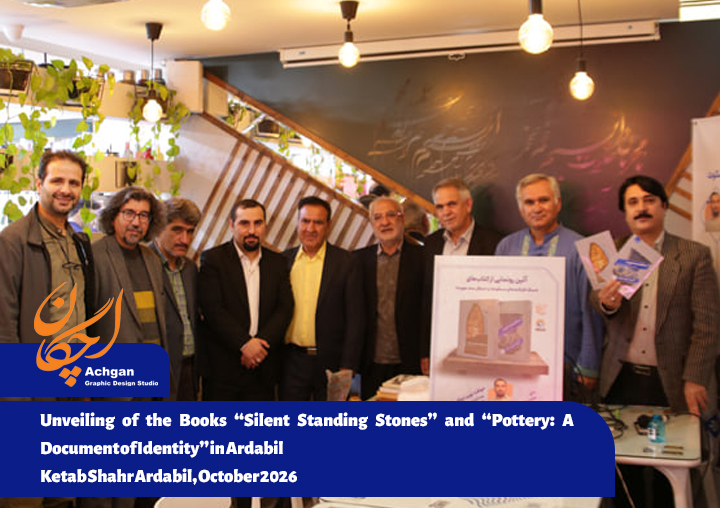
According to Nasim Ardabil, the books “Silent Standing Stones” and “Pottery: A Document of Identity”, authored by Navid Ahchgan, were unveiled at Ketab Shahr Ardabil with speeches from Dr. Hassan Yousefi, along with professors and artists in attendance.
Dr. Yousefi spoke about the history and antiquity of the Shahriyeri standing stone site, stating: “The Shahriyeri site was first identified in 1978 by the English archaeologist Charles Burney. The first excavation season at this site took place in 2003 (1382 in the Iranian calendar) under the supervision of Dr. Nobari, an archaeologist and university professor, for over a month. The goal was to classify the megalithic graves and identify nearby ancient sites. On 29 September 2002 (1381/07/07), the site was officially registered under number 6162 as Shahriyeri and the Ushaghlar School.” One of the unique historical sites of Meshginshahr County is this Shahriyeri site, which was once a town and settlement.
According to Dr. Yousefi, before the first millennium, during the Neolithic period, this area was inhabited and was part of a thriving regional civilization. Thus, Shahriyeri was one of the important settlements in the region during the late second millennium and early first millennium BCE.
The archaeological site extends along a north-south axis and features limestone stelae associated with the “Ushaghlar School” (“Children of the School”), which were used for religious ceremonies, including burial rites. Numerous ancient graves of the megalithic and Gurkan types—approximately 450 graves—have been identified here, along with a prehistoric cave and a mound dating to the Islamic period.
Shahriyeri Stelae (Stone Slabs)
A total of 397 stelae have been identified and examined. They are arranged in 16 different rows, some facing each other and others placed front-to-back. Based on physical structure, the stelae are divided into three categories:
-
Conical stelae: These have a rounded rectangular top and an arched back. They are generally under one meter in height.
-
Cuboid stelae: These have a cubical shape and are taller than the first type.
-
Tall rounded-back stelae: These are also cubical but have a rounded back and are the tallest stelae in the site.
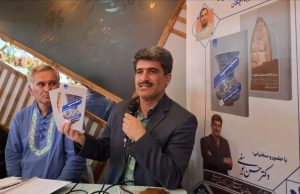
Navid Ahchgan, the author of the books “Silent Standing Stones” and “Pottery: A Document of Identity”, spoke about the Shahriyeri site:
“The standing stones of Shahriyeri are symbolic archaeological artifacts that convey deep metaphysical meanings and reflect the human relationship with life after death. The motifs on the stelae are human figures, mostly simple and abstract. Many of the stelae depict belts and daggers. In the most abstract stelae, except for one, the figures lack mouths. The stela that has a mouth symbolizes the ‘mother’, reflecting the significant role of mothers in the culture and society of that time. The mother’s words carried weight within the family, and all members respected her authority. The elevated status of the mother in the folklore and history of Azerbaijan regarded women as sacred. Hence, most stelae are depicted without mouths, emphasizing that one voice—the mother’s—should guide all. In Azerbaijani culture, with roots in the civilizations of the Mannaeans, Urartians, and Medes, the role of the mother was highly prominent, not only in biological terms but also in cosmic and ritual dimensions.”
Regarding his book “Pottery: A Document of Identity”, Ahchgan noted:
“Iran and Turkey, as two ancient lands and cradles of Islamic art, hold a distinguished place in the history of global pottery. Iranian pottery, in terms of both antiquity and technical diversity, predates Turkey. The influence of Iranian pottery is clearly seen in Iznik ceramics, from turquoise and cobalt colors to traditional motifs like the Shah Abbasi flower and Islimi patterns. According to researchers such as Arthur Pope, Julian Robinson, and Norbert Eschmeyer, many master artisans of Iznik originally migrated from Mosul, Tabriz, or Kashan to Anatolia, transferring their techniques to the Ottoman Empire.
In summary, in the historical and cultural interaction of pottery between Iran and Turkey, Iran served as the originator, while Turkey became the developer and institutionalizer of the art. Iranian pottery exhibits historical precedence, technical diversity, and aesthetic complexity. However, in the contemporary cultural economy and global presence, Turkey has made more effective strides. This interaction should not be viewed as negative competition but as a reflection of bilateral cultural potential, which through scientific, artistic, cultural, and media cooperation can become an opportunity to strengthen cultural diplomacy, achieve sustainable development, and preserve the artistic heritage of the Islamic world.”
Navid Ahchgan is a registered member of the Graphic Designers Association, a member of the Iranian Scientific Association, a member of the Contemporary Visual Arts Institute of Iran, and a senior art research expert. He is also the author of books on archaeology and art research, as well as the graphic designer for the office of the Supreme Leader’s representative in the province and the Ardabil Friday Imam.
Ahchgan has many years of experience in graphic design and media. He is a lecturer at Mohaghegh Ardabili University and has held numerous artistic and cultural roles, including:
-
Artistic Secretary of the 9th Biennial of Visual Arts of Basij, “Honarnegaar”
-
Scientific Secretary of the 11th University Festival of Movement
-
Secretary of the Best Nations Poster Festival
-
Executive Secretary of the Painting Exhibition of Caucasus Scholars
-
Secretary of the nationwide campaign “My Hero” (Menim Ghahramanim)
-
Secretary and Judge for the design competition of the National Congress Logo honoring 3,400 martyrs of Ardabil
-
Executive Secretary of the National Calligraphy Event of Iran Del
-
Executive Secretary of the Molaye Mehr Calligraphy Workshop
He has also organized two solo exhibitions, several group exhibitions, national and regional art calls, and has published numerous scientific and research articles.